
How European rearmament endangers peace and climate justice worldwide
During the next Global Week of Action for Peace and Climate Justice, 15-21st September 2025*, the European Network Against Arms Trade (ENAAT) organises an online panel on the consequences of EU militarisation for EU policies that contribute to peace and climate justice.
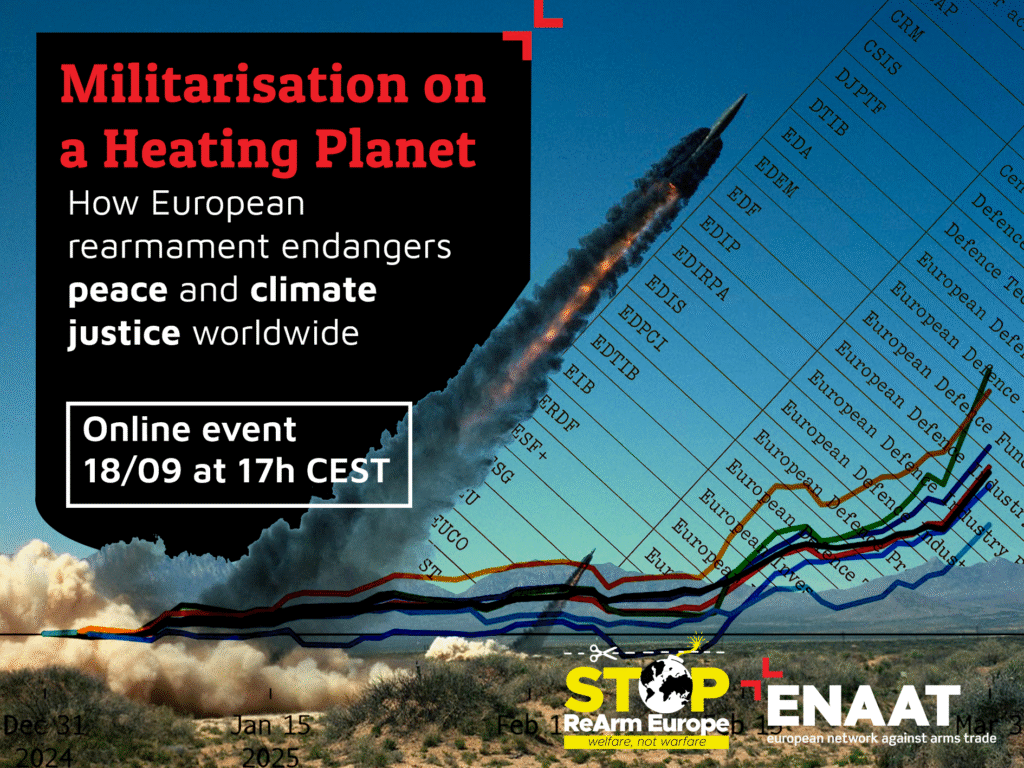
Rather than taking decisive action to stop escalating violence and climate disasters, world leaders are militarising at pace. As ever-more resources are directed away from peacebuilding, social welfare and climate action towards war and armed violence, it is essential that our movements come together to take action for a demilitarised just transition.
Rapid militarisation is presented as the only way of guaranteeing European security, preserve our prosperity and protect us against our enemies with deterrence through force. But while the EU is supporting the arms industry and developing policies to preserve Western hegemony, militarisation comes at a social and environmental cost. It is undermining arms export control, contributing to more insecurity and possible human rights violations, increasing GHG emissions & diverting critical resources from a just green transition.
In the panel, experts from environmental, climate justice and peace NGOs will discuss what redirecting money to militarisation and arms production means for the green transition, for the fight against climate crisis, and for peace and solidarity with the global south.
How will it influence the EU green goals? Is increased military production compatible with sustainability and long-lasting peace?
Short presentations will be followed by a discussion with the audience
Registration link: https://us02web.zoom.us/meeting/register/F1_BWUe7RFineVeLu1cpcQ
When: Thursday 18/09, 17h-18h15 CEST
Speakers:
- Laëtitia Sédou, ENAAT – EU militarisation, competitiveness and the global arms race
- Emilie Tricarico, European Environmental Bureau (EEB) – Is EU militarisation compatible with the fight against climate change & green transition?
- Olivier Petitjean, Observatoire des Multinationales – How raw materials critical for the green transition could be redirected to the military
- Anna Penfrat, Nonviolent Peaceforce (NP) – How EU peace-building policies are affected by EU militarisation
*The Week of Action for Peace and Climate Justice is part of the global Draw the Line September 2025 mobilisation, sown by indigenous leaders from the Amazon and the Pacific, now taken up by movements, communities, and allies demanding real climate justice.